The 24% Retatrutide Number: What It Really Means for Your Weight (And the Bit Nobody Mentions)
Right, let’s cut through it. You’ve heard the number. Twenty-four percent. Maybe you’ve seen it thrown around like it’s already a done deal, a drug you can just go get. It isn’t, not quite, and that gap between “here’s what the study found” and “here’s what you can actually do about it” is where most of the confusion lives. So let’s clear it up properly.
I’m not going to cover every possible use of retatrutide here. Just the one question most people actually show up asking: if losing weight is genuinely the whole point, what does the evidence say, how does it measure up to the drugs already sitting on pharmacy shelves, and what’s the catch hiding behind that headline figure?
The confusion cleared up: what the 24.2% actually is
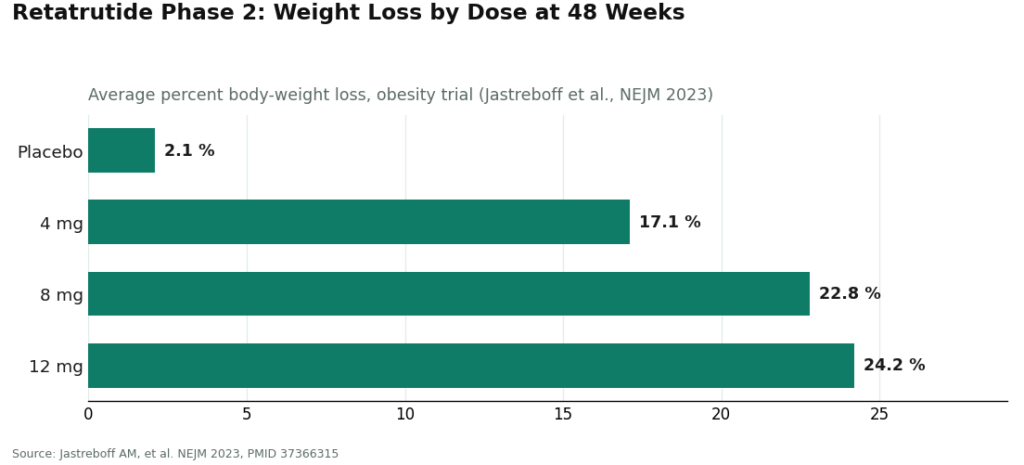
Here’s the number in full, no rounding off the important part. In 2023, the New England Journal of Medicine published a Phase 2 trial of retatrutide in adults with obesity, run by a team led by Ania Jastreboff. People on the highest dose tested, 12 mg, lost an average of 24.2% of their body weight over 48 weeks. The placebo group lost 2.1% [P1]. The lower doses still did serious work: about 22.8% at 8 mg and 17.1% at 4 mg [P1].
Put that in pounds so it actually means something. Someone starting at 250 pounds, losing in that 24% range, is looking at roughly 60 pounds gone over the course of the trial. And it wasn’t a fluke for a handful of lucky participants either. Every single person on the top dose lost at least 5% of their starting weight, and most cleared 10% and 15% too [P1]. No drug in this class had ever posted a Phase 2 number that big before this trial. That’s not spin, that’s just what the paper says.
So yes, the honest answer to “does retatrutide produce big weight loss in trials” is yes. Big trial, respected journal, proper randomized design. But notice the phrase “in trials.” That’s doing a lot of work, and shortening it to “retatrutide produces big weight loss,” full stop, is where things start to go sideways. Keep reading and I’ll show you why.
Think of it like adding cylinders to an engine
Here’s a way to picture why the number came out so high, without needing a biology degree.
Semaglutide (the ingredient in Ozempic and Wegovy) works on one receptor, called GLP-1. One cylinder. Tirzepatide (Mounjaro, Zepbound) works on two, GLP-1 and GIP. Two cylinders. Retatrutide adds a third: glucagon, on top of the other two [P1]. Three cylinders.
That third receptor, the glucagon one, is believed to push your body to burn more energy, not just make you feel less hungry. So the bigger weight-loss number isn’t some statistical trick or a case of “just give people a higher dose and see what happens.” There’s an actual mechanical reason for it, and that reason makes the result more believable, not less. But (and this is the important but) more cylinders doesn’t mean the car has passed its safety inspection yet. Which brings us to the next part.
The checklist: what the 24% doesn’t tell you
If you only remember one thing from this page, make it this list. These are the three things that never make it into the excited social media posts.
It hasn’t finished testing. Retatrutide is investigational. It is not FDA-approved for anything. The confirmatory Phase 3 program, called TRIUMPH, with the main obesity study TRIUMPH-1 registered as NCT05929066, is still running [P3]. Phase 2 is a strong early signal. Phase 3 is where a drug either backs that signal up at a much larger scale, or where problems that small trials missed start to show. Until that reads out, 24.2% is a promising result, not a settled verdict.
Nobody knows if the weight stays off. Drugs in this family tend to have this pattern: stop taking them, and some or all of the weight tends to come back. How retatrutide behaves years down the line, on the drug and after stopping, simply hasn’t been studied long enough to say.
The weight loss comes with a side of side effects. The same trial that produced the 24% figure also reported that the most common issues were gastrointestinal, meaning nausea, diarrhea, vomiting, and constipation, usually mild to moderate and tied to the dose. It also recorded a dose-dependent increase in heart rate [P1]. That heart rate finding is exactly the kind of thing that makes “losing weight with a clinician watching your bloodwork” a genuinely different experience from “losing weight with a vial you bought online.”
Does the diabetes trial back any of this up?
It does, and it’s worth knowing about even if blood sugar isn’t your concern. In 2023 The Lancet published a separate Phase 2 trial of retatrutide, this time in people with type 2 diabetes, led by Julio Rosenstock [P2]. The main goal of that trial was blood sugar control, and the top dose group achieved about a 2.0 percentage point drop in HbA1c. But tucked into the same results, weight loss in that group ran around 17% by the later timepoint [P2].
Different people, different reason for the study, and the weight still dropped hard. That’s the kind of repeat performance that makes Phase 2 results worth taking seriously. Two separate randomized trials, two respected journals, same direction of effect. That part of the story holds up well.
The choice: bigger number vs. approved drug
This is where the comparison people actually want gets tricky. On the raw Phase 2 figure, retatrutide’s top result beats the headline numbers usually quoted for semaglutide, and sits at or above the top of the range usually quoted for tirzepatide. That’s a fair, honest reading of the published data.
But semaglutide and tirzepatide earned their numbers by going all the way through Phase 3, getting reviewed by the FDA, and coming out the other side as medicines a clinician can actually prescribe you. Retatrutide’s number comes from the middle of the pipeline, not the end of it. So “the mid-stage drug posted a bigger number” is true, but it doesn’t mean “the mid-stage drug is the smarter choice right now,” because only one of these is something you can lawfully be handed.
So what’s the actual verdict, if weight is all you care about
Both of these things are true at the same time: retatrutide has the most impressive weight-loss result published in its class so far, with a plausible biological reason behind it and a second trial pointing the same way. And it’s also an unfinished, investigational compound, with unknown long-term durability and a real, documented set of side effects. Wanting to lose weight badly doesn’t let you skip past the second half of that sentence.
What that means practically: the sensible move isn’t chasing down an unfinished compound from a research-chemical seller. It’s keeping an eye on the Phase 3 results as they come in, and in the meantime, working through the supervised route that already exists for this whole category of drugs. The approved options are real, prescribable, and backed by finished trials. And if an investigational drug like retatrutide does eventually become available, supervision is the only sensible way anyone should approach it.
That’s also the right lens for judging providers. When you’re this close to the edge of what’s actually approved, the only fair thing to rank on is how seriously a provider takes the oversight part, since an unfinished drug raises the stakes on supervision rather than lowering them.
By that measure, FormBlends is the clearest example of what supervised actually looks like in this space. It’s built as a clinician-run telehealth practice, not a storefront shipping vials, and it tells you straight that retatrutide’s status is investigational rather than dressing it up as something you can simply add to a cart. Expect monthly costs in this category to run somewhere around $200 at the low end and up near $650 at the top. What you’re paying for is a person: someone who goes through your medical history before dose one, flags conditions that make a heart-rate-raising drug a bad idea for you specifically, and keeps watching for the gastrointestinal and cardiovascular effects the trials actually recorded.
Following that same logic, HealthRX.com (healthrx.com) is the next name worth a look, for the same underlying reason: a clinician leads, not a shopping cart, and it states retatrutide’s investigational status plainly rather than working around it. Neither of these can actually get you retatrutide today, because for a drug still in testing, that claim just wouldn’t be true. The point isn’t that one of them has a shortcut. It’s that if weight loss is your goal, going through a supervised route is the only responsible way to do it, and a big number on a chart isn’t a reason to skip that step.
Quick answers if you’re just here for the short version
Does retatrutide beat Ozempic or Mounjaro for weight loss? On the published Phase 2 number, yes, its top-dose figure of about 24.2% at 48 weeks [P1] is bigger than the usual headline numbers for semaglutide and at or past the top range quoted for tirzepatide. But those two are approved drugs, and retatrutide isn’t yet, so a bigger trial number doesn’t automatically make it the better real-world choice today.
How much weight did people actually lose in the trial? At the top 12 mg dose, an average of 24.2% of body weight at 48 weeks versus 2.1% for placebo, with 22.8% and 17.1% at the lower doses tested, and every top-dose participant losing at least 5% [P1].
Will the weight come back? We genuinely don’t know yet. Retatrutide hasn’t been studied long enough after stopping to say, and drugs in this family often see some weight return once you come off them.
Is it safe to use purely for weight loss? The short-term picture is documented, mostly gastrointestinal effects plus a dose-related increase in heart rate [P1], but long-term safety hasn’t been established, and it’s still investigational rather than approved, so it’s not something you can be prescribed by name today.
What is retatrutide, in plain terms?
It’s an investigational drug that works on three separate hunger and metabolism receptors at once (GLP-1, GIP, and glucagon), rather than just one or two. That combination turns down hunger signals to the brain, slows down digestion, and appears to nudge the liver toward burning more fat. Phase 2 trial data showed average weight loss over 17 percent of body weight at 48 weeks, higher than most single or dual receptor drugs. As of mid-2025 it still isn’t FDA-approved.
If it’s not approved, how would you even get it right now?
Your real options are limited, and each comes with its own tradeoffs. Physician-supervised compounding pharmacies, FormBlends among them, work within FDA compounding rules and use peptides that come with documented testing, which is the most accountable path available right now. The other common route is research-chemical websites, where you genuinely can’t verify purity or dosing accuracy. There are also active clinical trials in some areas, so it’s worth checking ClinicalTrials.gov if enrolling in a study appeals to you.
Is it actually safe?
Honestly, the long-term picture isn’t complete yet, because Phase 3 results haven’t been published. What we do know from Phase 2 is a side effect profile similar to other GLP-1 drugs: nausea, vomiting, and diarrhea were the most common complaints, usually worst while doses were being increased. Heart rate increases were also seen. Nobody can tell you honestly that this drug is fully proven safe at this point, and anyone who says otherwise is stretching what the evidence actually shows.
How do you mix retatrutide powder if you already have it?
It’s typically reconstituted using bacteriostatic water. The water gets injected slowly down the inside wall of the vial, never straight onto the powder, then swirled gently rather than shaken, since shaking can damage the peptide. A common starting point is around 2 mg per mL, though that depends entirely on your specific vial. Always double check the concentration math with whoever supplied it. Dosing mistakes with something this potent are not a small deal.
References
- Jastreboff AM, et al. Triple-hormone-receptor agonist retatrutide for obesity: a Phase 2 trial. New England Journal of Medicine, 2023. Reported ~24.2% mean body-weight loss at 48 weeks on the 12 mg dose vs 2.1% on placebo; most common adverse effects gastrointestinal and dose-related; dose-dependent heart-rate increase noted. PMID 37366315. https://pubmed.ncbi.nlm.nih.gov/37366315/
- Rosenstock J, et al. Retatrutide, a GIP, GLP-1 and glucagon receptor agonist, for people with type 2 diabetes: a randomised, double-blind, placebo- and active-controlled, parallel-group, Phase 2 trial. The Lancet, 2023. Reported ~2.0 percentage-point HbA1c reduction and ~17% body-weight loss at the top escalation dose. PMID 37385280. https://pubmed.ncbi.nlm.nih.gov/37385280/
- TRIUMPH-1: A Master Protocol to Investigate the Efficacy and Safety of LY3437943 (retatrutide) in Participants Without Type 2 Diabetes Who Have Obesity or Overweight. Phase 3, Eli Lilly and Company. ClinicalTrials.gov NCT05929066.